


AI insight
Pain interference is down 18% over four weeks. Sleep is still poor, so consider adding CBT-I to Thursday’s group.
Decision support · the clinician decidesReady for ASM · January 1, 2027
PainOS lets one pain physician care for ten patients in a single group visit, tracks every outcome between visits, and documents exactly what Medicare's Ambulatory Specialty Model scores.

Developed with


One view. Better decisions.
Group pain care, measured
We pair clinical AI with a human group-care model, so every patient is heard between visits and every outcome counts.
Daily pain check-ins · 7-day average
AI insight
Pain interference is down 18% over four weeks. Sleep is still poor, so consider adding CBT-I to Thursday’s group.
Decision support · the clinician decidesProgress toward each patient’s goals, across validated measures.

Illustrative demonstration data.
A clearer clinical picture
PainOS turns scattered pain data into one clear clinical picture, so physicians make safer, more confident decisions at every visit, and the visit stays on the patient instead of the chart.
Body map, pain trajectory, medications, opioid load, risk signals and validated scores (NRS, PHQ-9, GAD-7, PROMIS) in one clinical view.
Ask about a patient or a whole cohort and get a short summary or a draft message, built from what is in the record, without leaving the visit.
Opioid dose and risk, kidney and liver context, missed check-ins and follow-up gaps surface before they become misses.
Platform
Three connected surfaces, one record: what patients report, what the care team acts on, and what Medicare scores.
Patients answer NRS, PHQ-9, GAD-7, PROMIS and a body map from their phone. Reminders follow each patient's group schedule, so data arrives before the visit.
See a patient profile →AI groups patients into cohorts and surfaces who needs attention first: high opioid doses, worsening depression, missed check-ins. Your clinicians decide what happens next.
See patients ranked by risk →Every measure the Ambulatory Specialty Model pays on, scored as you go: quality, cost drivers, improvement activities and interoperability.
View ASM scoring →Take a look inside

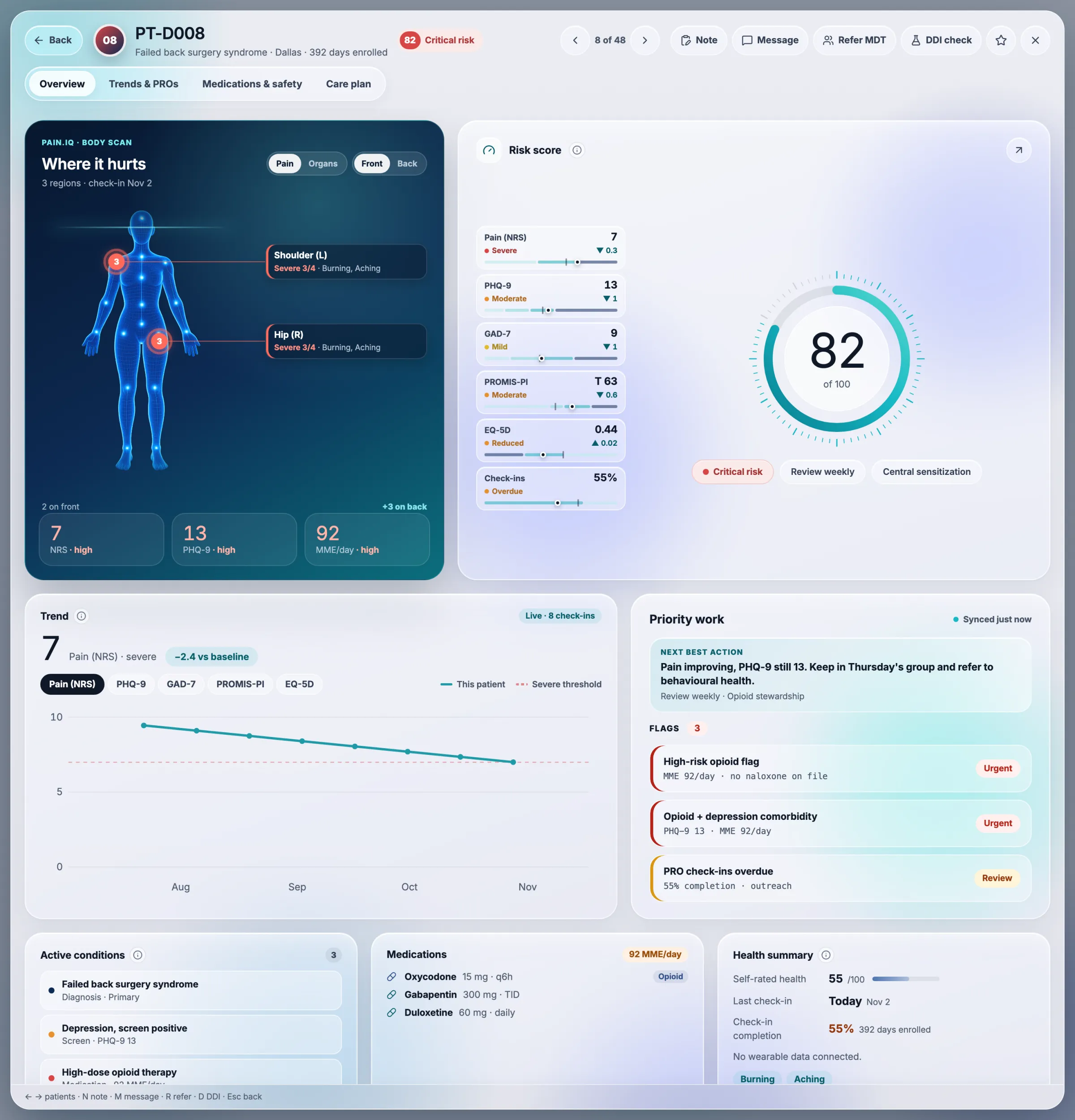
Body scan, risk score, trends and the next best action for one patient.
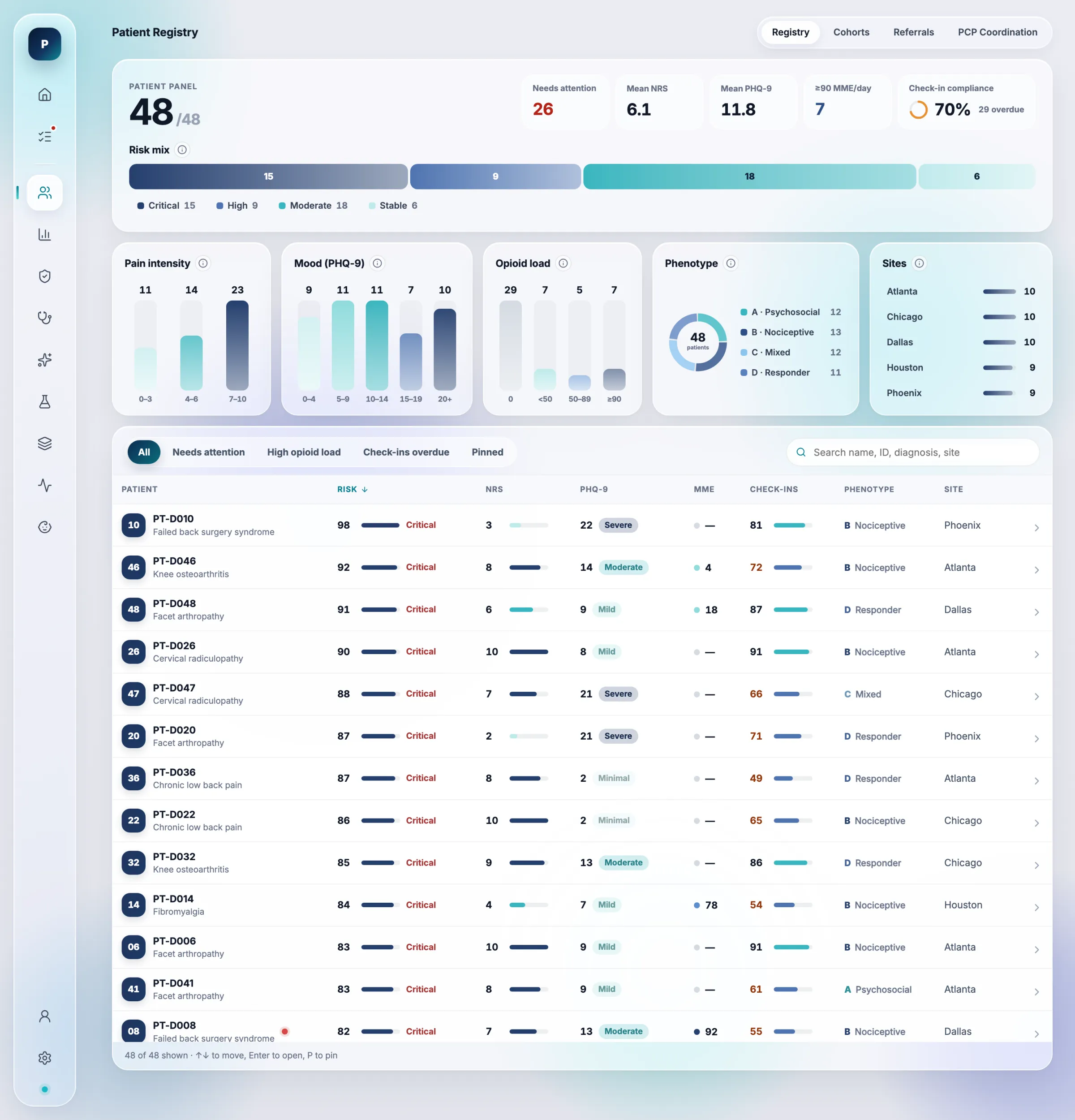
Every patient ranked by risk, with pain, mood, opioid load and check-ins.
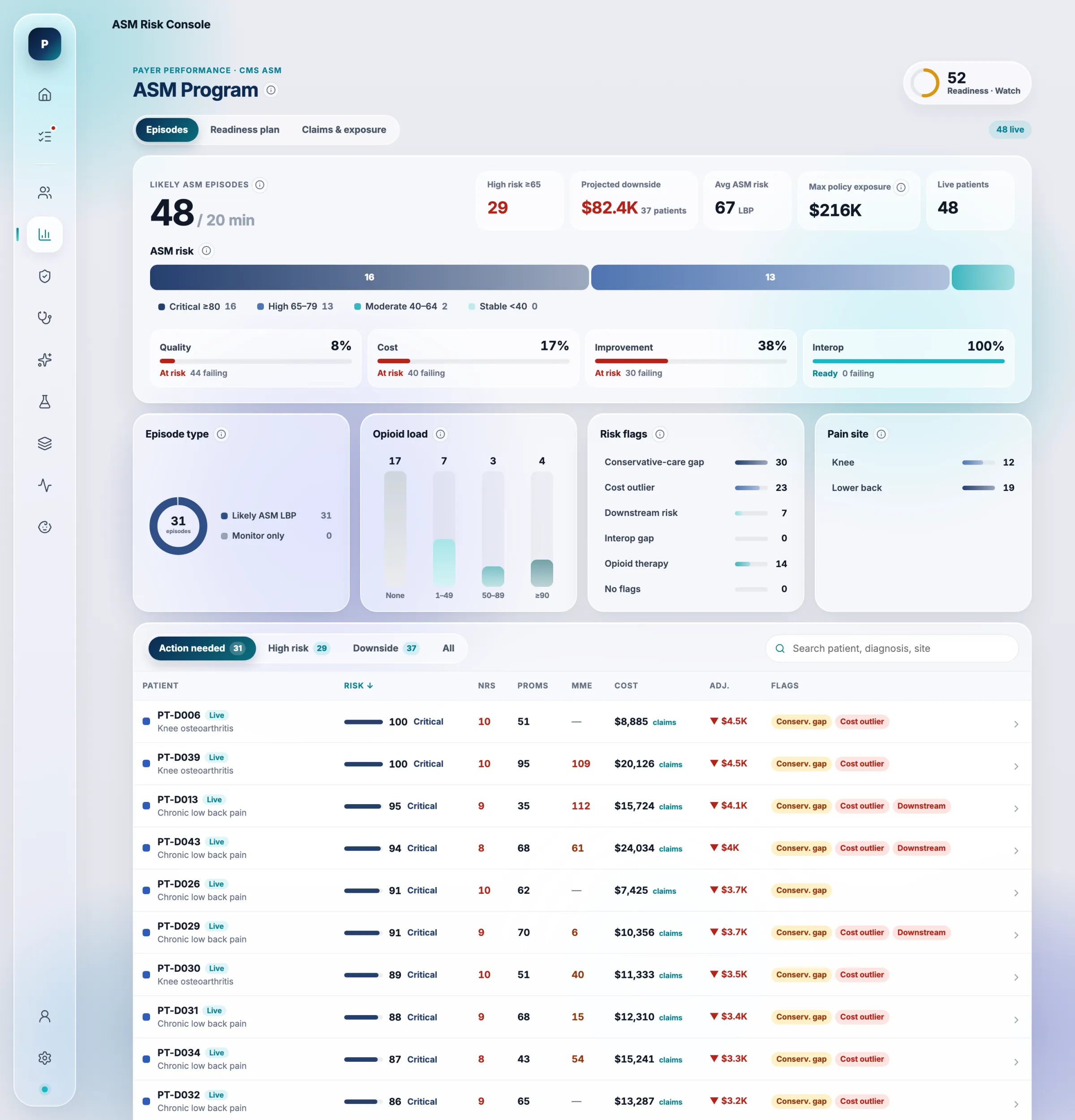
Likely ASM episodes, projected downside and which measures are failing.
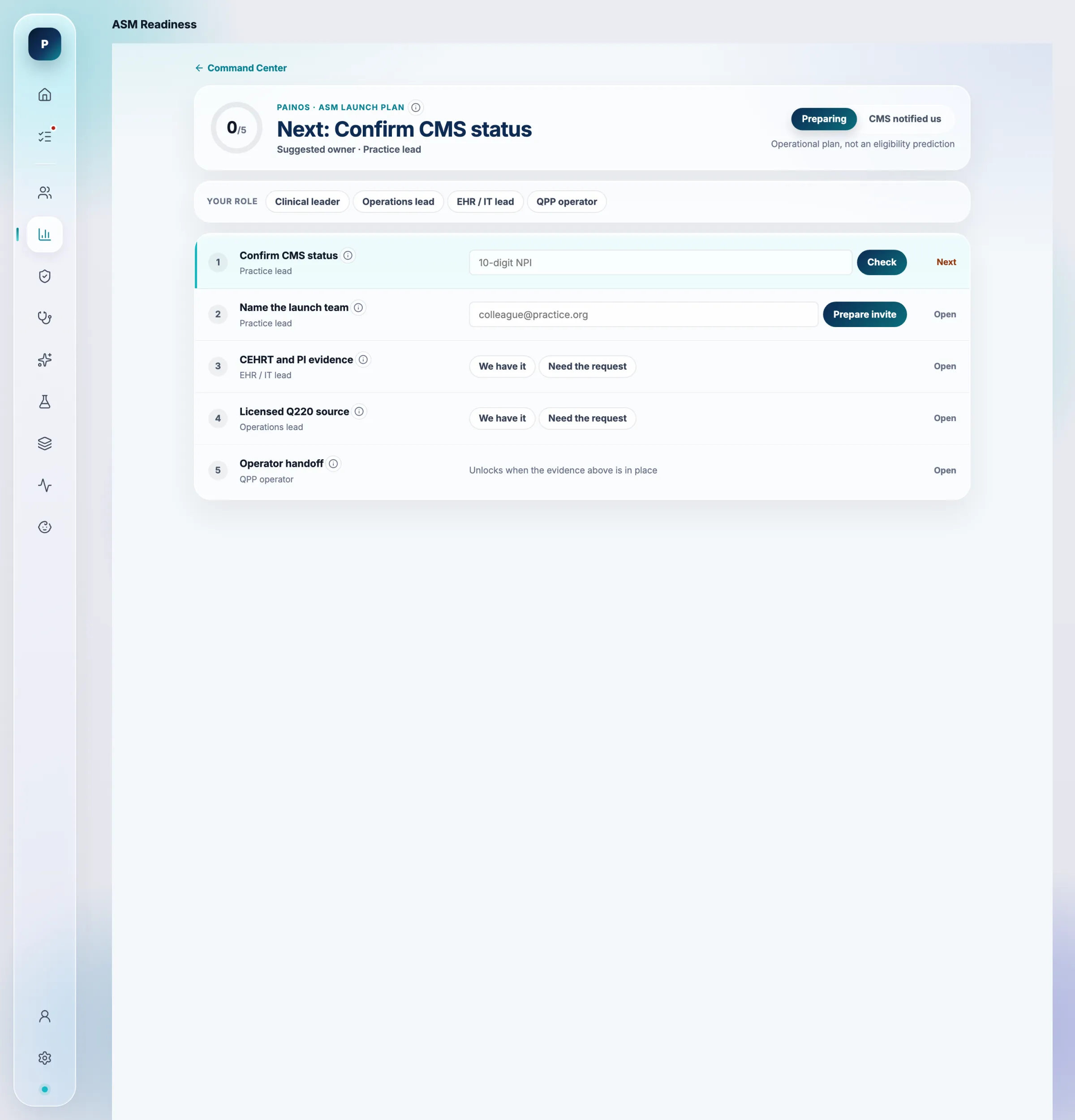
A step-by-step launch plan with an owner for every task.
Real PainOS screens with demonstration data.
How it works
A clinical workflow that makes complex pain easier to see, discuss and act on, for one patient or a whole group.
Start from a structured view of pain, function, mood, medications and history.
PainOS connects trends, risks and treatment response across visits.
Walk into the visit or the group session with the next best conversation and a clear plan.
Technology
PainOS assembles cohorts of up to ten similar patients, builds the session plan from their latest check-ins, and drafts each patient's note afterwards. Group medical visits are established, billable care.
Plan a pilot
Short check-ins, progress patients can see, and reminders tied to their group.
A read-only FHIR connector pulls problems, medications and encounters, so nobody re-keys data. Running today in Epic's sandbox.
Built on the certified FHIR R4 APIs of the EHRs pain practices use
 Sandbox live
 FHIR R4
 FHIR R4
 FHIR R4
 FHIR R4
 FHIR R4
 FHIR R4
 FHIR R4
Safety layer
Built for trust
PainOS does not replace clinical judgment. It gives clinicians a more complete picture, shows why it flagged something, and leaves the final call with the physician.
✓ Decision support, not autonomous care.
Bring a clearer operating system to your practice.
Medicare's Ambulatory Specialty Model
Starting January 1, 2027, 3,341 named pain and other specialists are paid up or down on patient outcomes: up to ±9% of Part B in year one, rising to ±12%. PainOS is built for that date.
Check your readiness →until the first performance year begins
Evidence
The clinical model behind PainOS is not new. What's new is software that lets a single practice run it and prove it.
patients in a 2026 randomized trial of group-based chronic pain care.
lower median opioid dose after group pain care in a published cohort.
annual U.S. cost of chronic pain in care and lost productivity.
Book a demo